MDAnalysis UGM 2023: MDAnalysis Parallelization @ GSOC
The content below is one-to-one a content of my MDAnalysis User Meeting in September 2023.
Parallelization of MDAnalysis #
Egor Marin, Google Summer of Code contributor
Motivation #
T(insight) = T(simulation) + T(analysis)pmda: 30⭐️, 21🍴 (forks)- all MDAnalysis instances are parallelizable (courtesy @yuxuanzhuang)
Goals #
Change AnalysisBase in a way that…
- Introduces multiple job support
- local – using multiprocessing?
- non-local – using dask?
- Does not break existing code (subclasses, dependencies, etc)
- Allows customization
- add your own execution backend
- write your own parallelizable classes
Sneak peak: results #
>>> from MDAnalysis.analysis.rms import RMSD
>>> u, ref = ...

>>> % time long_run = RMSD(u, ref)
Wall time: 4 min

>>> % time long_run = RMSD(u, ref, backend='multiprocessing', n_workers=8)
Wall time: 50 secSneak peak: results #
>>> from MDAnalysis.analysis.rdf import InterRDF
>>> s1, s2 = ...

>>> % time long_run = InterRDF(s1, s2)
Wall time: 1 h

>>> % time long_run = InterRDF(s1, s2, backend='multiprocessing', n_workers=8)
Wall time: 8 min Implementation #
General AnalysisBase.run() protocol:
def run(self,
        start=None,
        stop=None,
        step=None,
        frames=None, ...):

  # prepare frames -- check boundaries, setup reader
  self._setup_frames(self._trajectory, start=start, stop=stop, step=step, frames=frames)

  # initialize attributes with intermediate results
  self._prepare()

  # go through trajectory
  for i, ts in enumerate(self._sliced_trajectory, ...):
    self._single_frame()

  # convert intermediate results into final ones
self._conclude()Implementation #
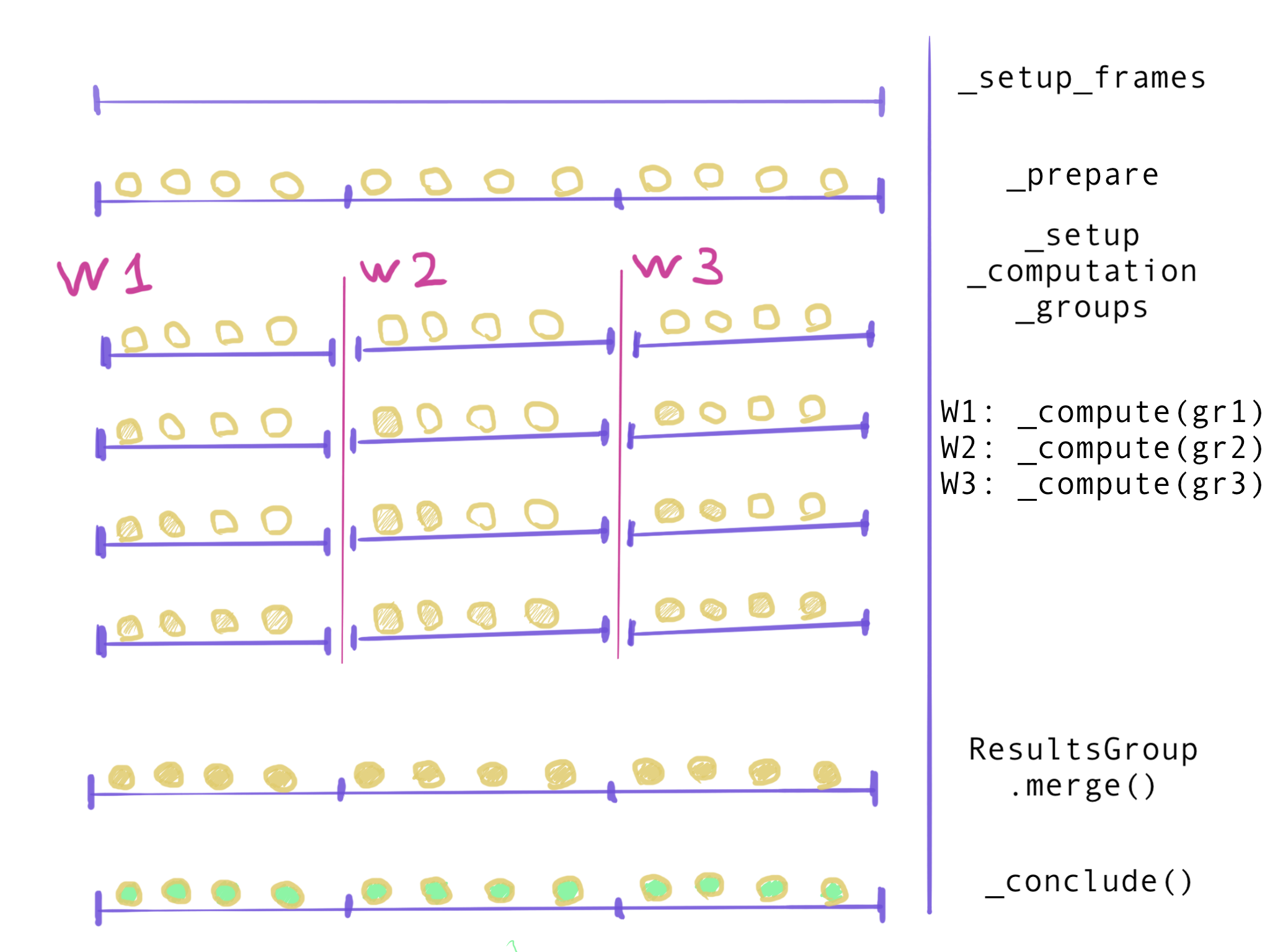
split-apply-combine:
- split all frames into groups
- process each group independently
- combine results
Implementation #
Additional methods of AnalysisBase:
- “split”:
_setup_computation_groups() - “apply”:
_compute - “combine”:
_get_aggregator&ResultsGroup.merge() - housekeeping:
_configure_backend
Implementation #
Implementation #
Additional classes: ResultsGroup
class ResultsGroup:
    def __init__(self, lookup: dict[str, Callable]): ...
    def merge(
        self, objects: Sequence[Results], require_all_aggregators: bool = True
) -> Results: ...Implementation #
Additional classes: ResultsGroup
>> from MDAnalysis.analysis.parallel import ResultsGroup, Results
>> group = ResultsGroup(lookup={'mass': lambda values: np.mean(values)}
>> obj1 = Results(mass=1)
>> obj2 = Results(mass=3)
>> group.merge([obj1, obj2])
{'mass': 2.0}Implementation #
Additional classes: ResultsGroup
# skip attributes you don't want to aggregate
>>> lookup = {'mass': ResultsGroup.float_mean, 'trajectory': Trajectory}
>>> group = ResultsGroup(lookup)
>>> objects = [Results(mass=1, trajectory=None), Results(mass=3, trajectory=Trajectory(...))]
>>> group.merge(objects, require_all_aggregators=False)
{'mass': 2.0}Implementation #
Additional classes: BackendBase
from MDAnalysis.parallel import BackendBase


class CustomBackend(BackendBase):
    def __init__(self, some_resource):
        self.some_resource = some_resource

    def apply(self, func: Callable[T, R], computations: list[T]) -> list[R]:
        results = [self.some_resource.do_compute(func, task) for task in computations]
return resultsImplementation #
Additional classes: BackendBase
>>> backend_instance = CustomBackend(some_resource=...)
>>> my_run = RMSD(u, ref)
>>> my_run.run(backend=backend_instance, unsafe=True)Implementation #
Conditions for the backend=...
Subclass.is_parallelizable() == Truebackend: str|BackendBase- if
str, one of built-in backends (multiprocessing/dask) - if
BackendBasesubclass, explicitly sayunsafe=True
- if
Add to your subclass #
Example: RMSD
from MDAnalysis.analysis.parallel import ResultsGroup


class RMSD(AnalysisBase):
    @classmethod
    @property
    def available_backends(cls):
        return (
            "serial",
            "multiprocessing",
            "dask",
        )

    @classmethod
    @property
    def is_parallelizable(self):
        return True

    def _get_aggregator(self):
return ResultsGroup(lookup={"rmsd": ResultsGroup.ndarray_vstack})How fast #
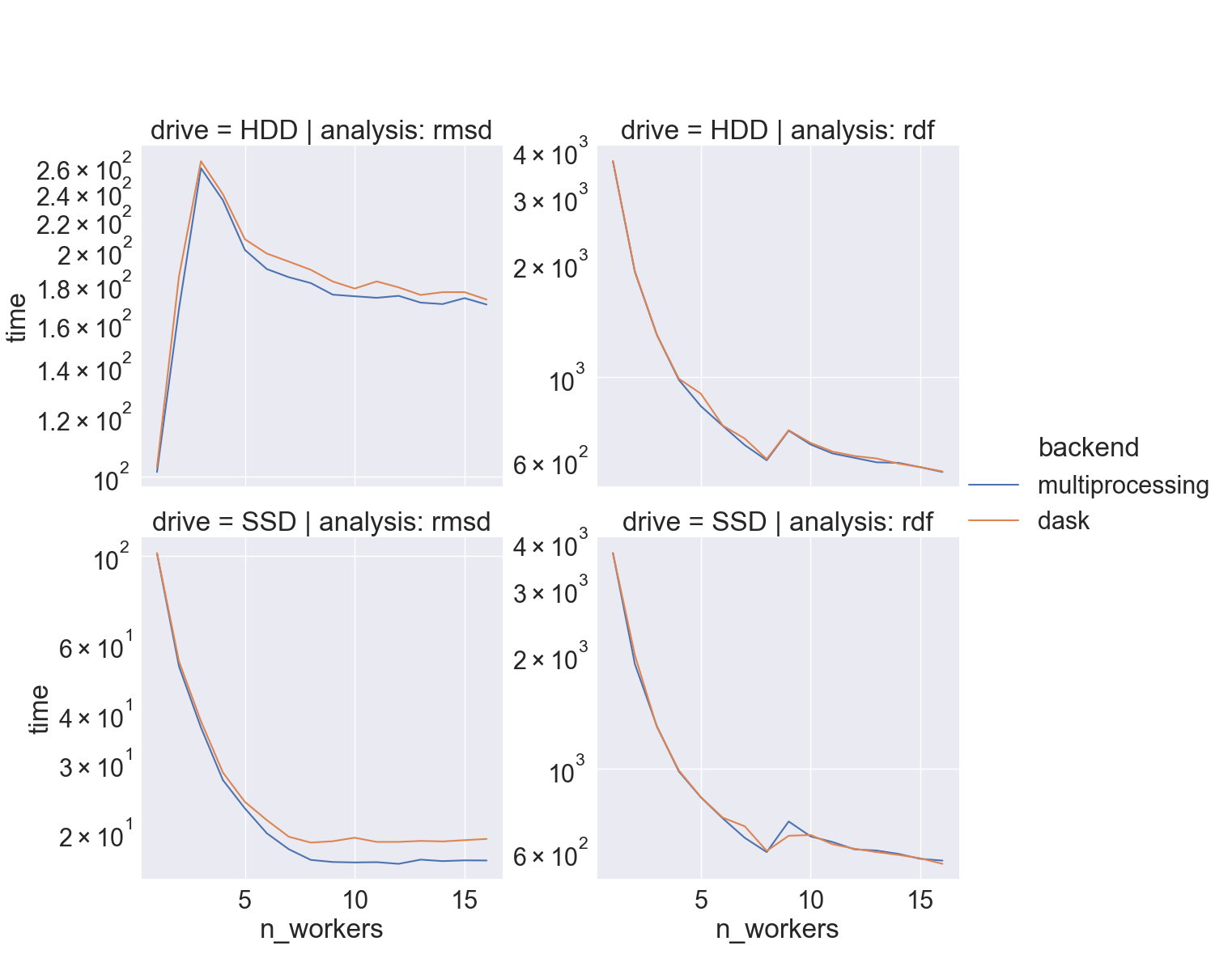
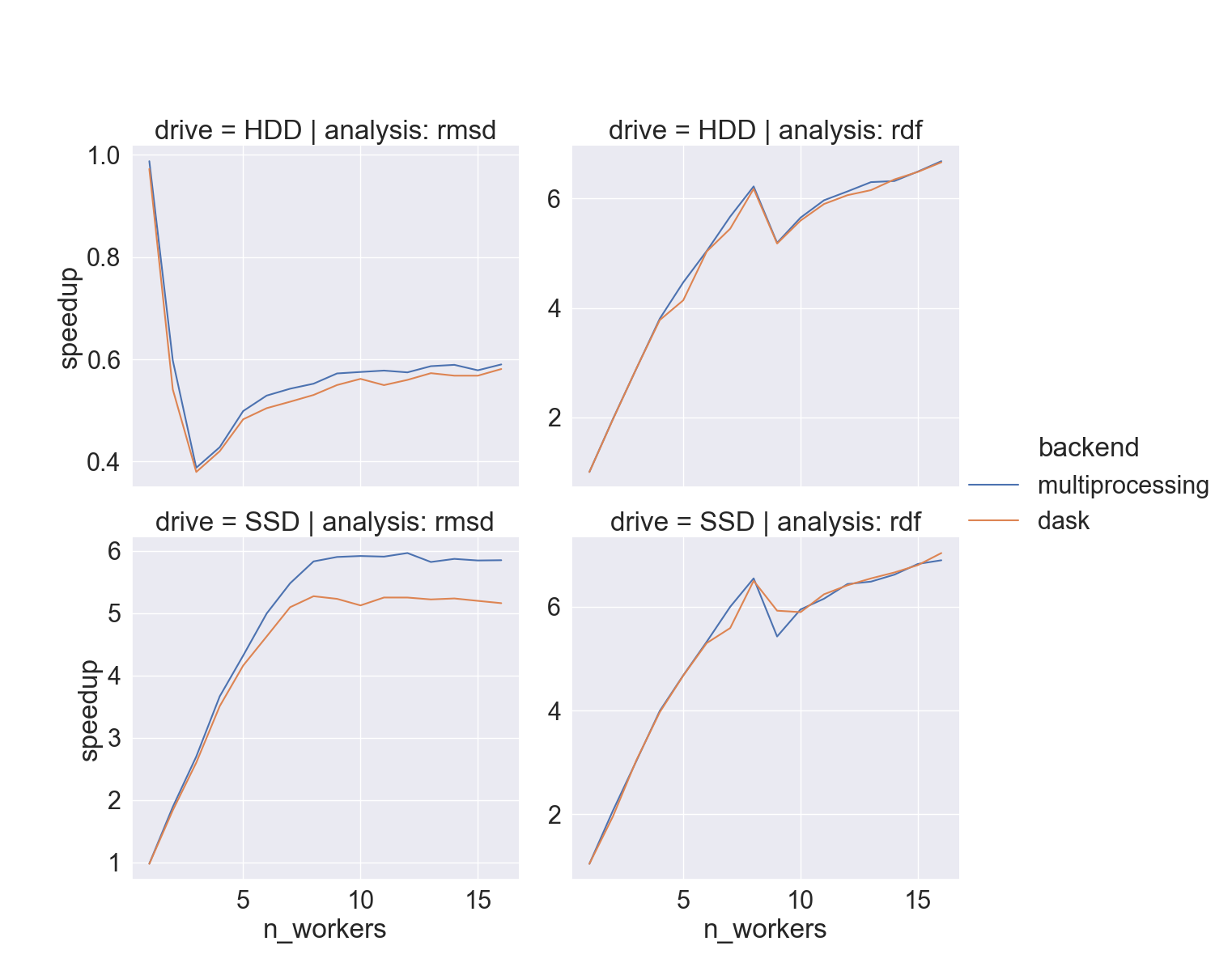
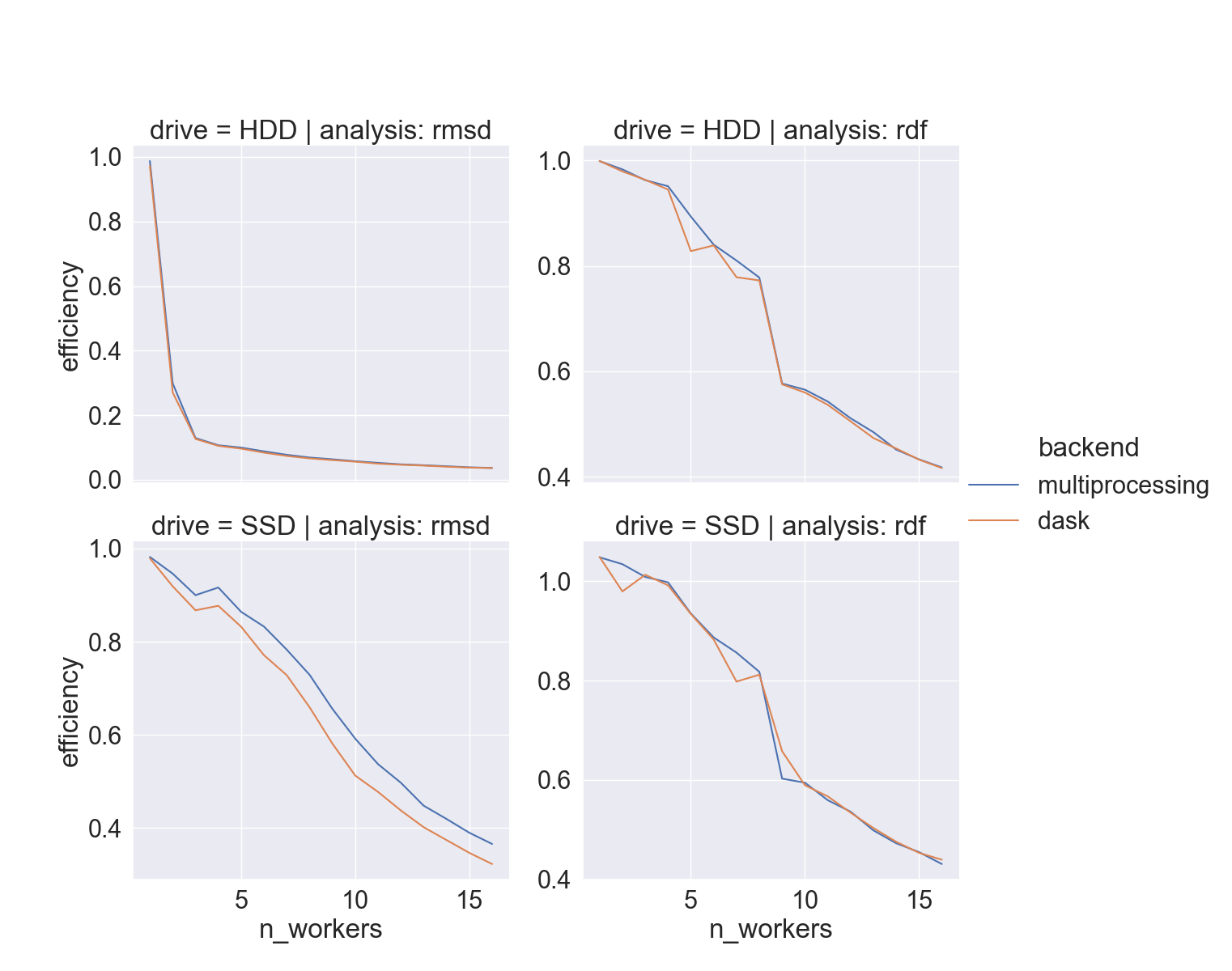
- full-atom
xtc(“lysozyme in water”) - two different drives,
hdparm:- HDD: 180 MB/sec
- SSD: 460 MB/sec
- i9-9900K CPU @ 3.60GHz, 8 cores/socket
How fast #
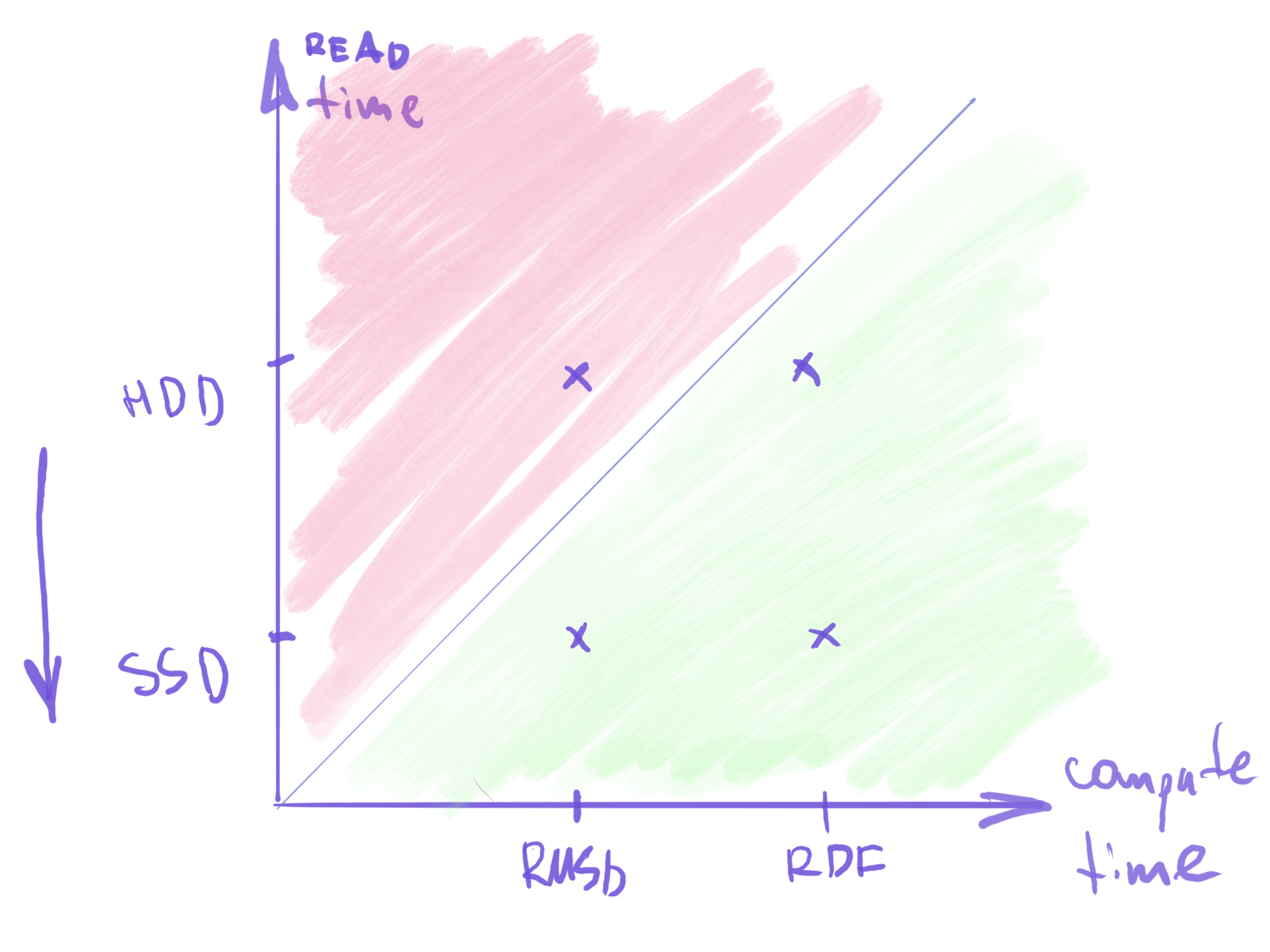
When should I use it #
Definitive answer: benchmark it yourself!
%%timein jupyter notebookstep=MANYorstart=0, stop=10_000to achieve ~1-2 minute runtime with serial scheduler
When should I use it #
YourClass.is_parallelizable()for your class_single_frame()slower than reading from disk
Future features #
- 🔜 add to all subclasses
- have separate issues for complicated ones?
- 🔜 add tutorials
- how to use parallel backends
- how to implement your own backend subclasses
Future features #
- 🤔 add distributed support
- rebrand
pmdainto MDAKit - focus on parallel filesystems, etc
- rebrand
- 🤔 add shareable memory trajectories
- pre-load trajectory & analyze it
- efficient for practically all subclasses
- 🤔 add
AnalysisCollection(ht @PicoCentauri)- one frame read exactly once
Acknowledgements #
- Google Summer of Code 2023 program

Acknowledgements #
- Mentors:
- Yuxuan Zhuang @yuxuanzhuang
- Oliver Beckstein @orbeckst
- Rocco Meli @RMeli
- 💫 Paul Smith @p-j-smith
- all contributors🫶